Showing posts with label MA.. Show all posts

Wednesday, October 7, 2015

Holiday living arrangements instead of cut flowers in your Boston, MA interior office design.

poinsettias; amyrilis;english ivy; interior office care; interior office design;
Holiday Living Arrangement

1. Why living flower arrangements for your Boston office work place? Because they last longer then cut flowers in a vase of water.

2. These creative interior plantscape garden arrangements last longer then your daily or weekly Boston cut flower vase programs.

3. Because of their roots are still in moist soil the flowers can flourish and even grow in these arrangements. Visit our PDIPLANTSBlog.com for more info.

4. The poinsettia thrives in its own soil, which makes them great indoor office plants.  The double amaryllis is actually ready to bloom feeding off of its own bulbous food supply, naturally containing all of its own nutrients that it needs to have bright vibrant blooms.

5. The white and red Kalanchoes last long because the flowers still have their own roots to take up necessary water and nutrients.

6. Lastly the English Ivy, a great interior office plant, can even grow longer and fuller because they have not been manually ripped from they root structure.

7. Plantscape Designs Inc. delivers these living arrangements all across our NE Plantscape and the Boston, MA areas. We give our unlimited plant care service with each arrangement.

Plantscape Designs Inc. of Stoneham, MA services the following area cities and towns in Massachusetts:


    • Boston, MA
    • Cambridge, MA
    • Wakefield, MA
    • Woburn, MA
    • Peabody, MA
    • Wilmington, MA
    • Tewksbury, MA
    • Methuen, MA
    • Needham, MA
    • Andover, MA
    • Dedham, MA 

    • Andover, MA
    • Westboro, MA
    • Acton, MA
    • Westford, MA
    • Chelmsford, MA
    • Billerica, MA
    • Burlington,MA
    • Bedford, MA
    • Lexington, MA
    • Wellesley, MA
    • Watertown, MA
    • Lynnfield, MA
    • Danvers, MA
    • Saugus, MA
    • Beverly, MA
    • Salem, MA
    • Reading, MA
    • North Reading, MA
    • Marlboro, MA
    • Southboro, MA
    • Northboro, MA
    • Stoneham, MA


    Tuesday, June 24, 2014

    Yellow Bromeliads are coming for our clients this year, Burlington, MA.


    1. Yellow guzmanias are coming this year for all our clients.

    2.  Bromeliads are related to other epiphytes such as spanish moss, tillanzias and orchids, do not need soil to grow in. These "air plants" just require moisture and minerals from their surrounding atmosphere.

    3. Epiphytes live in tropical rain forests in South America as as well as subtropical areas as our Carolines and Florida ,USA.

    4.You will see our Plantscape Designs' staff misting these plants repeatedly simulating the tropical humid forests in our southern hemisphere. Your Boston interior officescapes as well as with many of your other indoor office plants will be repeatedly misted to keep them healthy. PDI services the Boston, MA. Waltham, MA.Cambridge, MA. office buildings.

    Tuesday, June 21, 2011

    How do you properly water your indoor office plants in Burlington, Ma?


    Incorrect watering is a common factor in plant failure. Roots suffocate in soggy compacted soil. Plants die if they do not get enough water. When a plant needs water, water it thoroughly until water comes out the bottom of the pot (if in a drained container).

    Make sure the soil is saturated and the excess is drained away. Do not allow a plant to sit in water for a long period of time. Check your plants often. Water only those that show the need for water with room temperature water. Do not use water that has been chemically softened, as it is toxic to plants.

    1. Plants that need to stay moist should be watered as soon as the surface of the soil
    is dry to the touch.

    Plants in small pots, 4” diameter, especially in sunny windows
    Hanging Plants: Boston Fern, Piggybacks, Gesneriads, asparagus fern, variegated english ivy, English Ivy, swedish ivy, Ferns
    Table plants: Babies Tears, Ferns, Orchids

    2. Plants that need to dry moderately should be watered when the soil is dry about
    1/4 of the way through the pot.

    Floor plants: Aglaonema (Chinese Evergreen), Aspidistra (cast iron Plant),
    several Dracenenas: Janet Craig, Warneckei, and Massangeana (Corn Plant), Sansevieria (snake plant or mother-in-law’s tongue), Neanthebella Palm (Parlor Palm) Most Palms, Orange Trees, Rubber Trees, Ficus Benjamina (weeping Fig), Areca Palms, Crotons, Aralias, Norfolk Island Pines, Schefflera (umbrella tree), Philodendron, Ponytail Palm, Dracenenas (Corn Plants) Pleomele, Spathiphyllum (peace lily), Rhapis (Lady Palm), Arboricola (mini umbrella tree), Dracenena Marginata (Dragon Tree - green and white variety not “rainbow” this is Partial Sun)
    Hanging Plants: Boston Fern, Lipstick vine, Grape Ivy, Piggybacks, Gesneriads asparagus fern, begonias, variegated english ivy Pothos, English Ivy Spider plants, swedish ivy, Ferns
    Table plants: Aglaonema (Chinese Evergreen), Sansevieria (snake plant or mother-in-law’s tongue), Mini Spathiphyllum (peace lily), Pothos, African Violets, Babies Tears, Bromeliads, Ferns, Orchids.

    3. Plants that need to dry completely should be watered when the soil is dry 3/4
    of the way through the pot.
    Such as :all cacti, jerusalem cherry, Succulents etc.

    Plantscape Designs Inc. of Burlington, MA waters for the appropriate needs of your interior office plants and for your specific office environment.

    Thursday, October 7, 2010

    Phototropism whats that?


    1.Phototropism is directional growth in which

    the direction of growth is determined by the direction of the light source.

    2. In other words, it is the growth and response to a light stimulus. Phototropism is most often observed in plants.

    3.The cells on the plant that are farthest from the light have a chemical called auxin that reacts when phototropism occurs. This causes the plant to have elongated cells on the farthest side from the light.

    4.Phototropism is one of the many plant tropisms or movements which respond to external stimuli. Growth towards a light source is a positive phototropism, while growth away from light is called negative phototropism.

    5. Most plant shoots exhibit positive phototropism, while roots usually exhibit negative phototropism, although gravitropism may play a larger role in root behavior and growth. Some vine shoot tips exhibit negative phototropism, which allows them to grow towards dark, solid objects and climb them.


    6. Phototropism is enabled by auxins.

    7.Auxins are plant hormones that have many functions. In this respect, auxins are responsible for expelling protons (by activating proton pumps) which decreases pH in the cells on the dark side of the plant. This acidification of the cell wall region activates enzymes known as expansins which break bonds in the cell wall structure, making the cell walls less rigid.

    8. In addition, the acidic environment causes disruption of hydrogen bonds in the cellulose that makes up the cell wall. The decrease in cell wall strength causes cells to swell, exerting the mechanical pressure that drives phototropic movement.

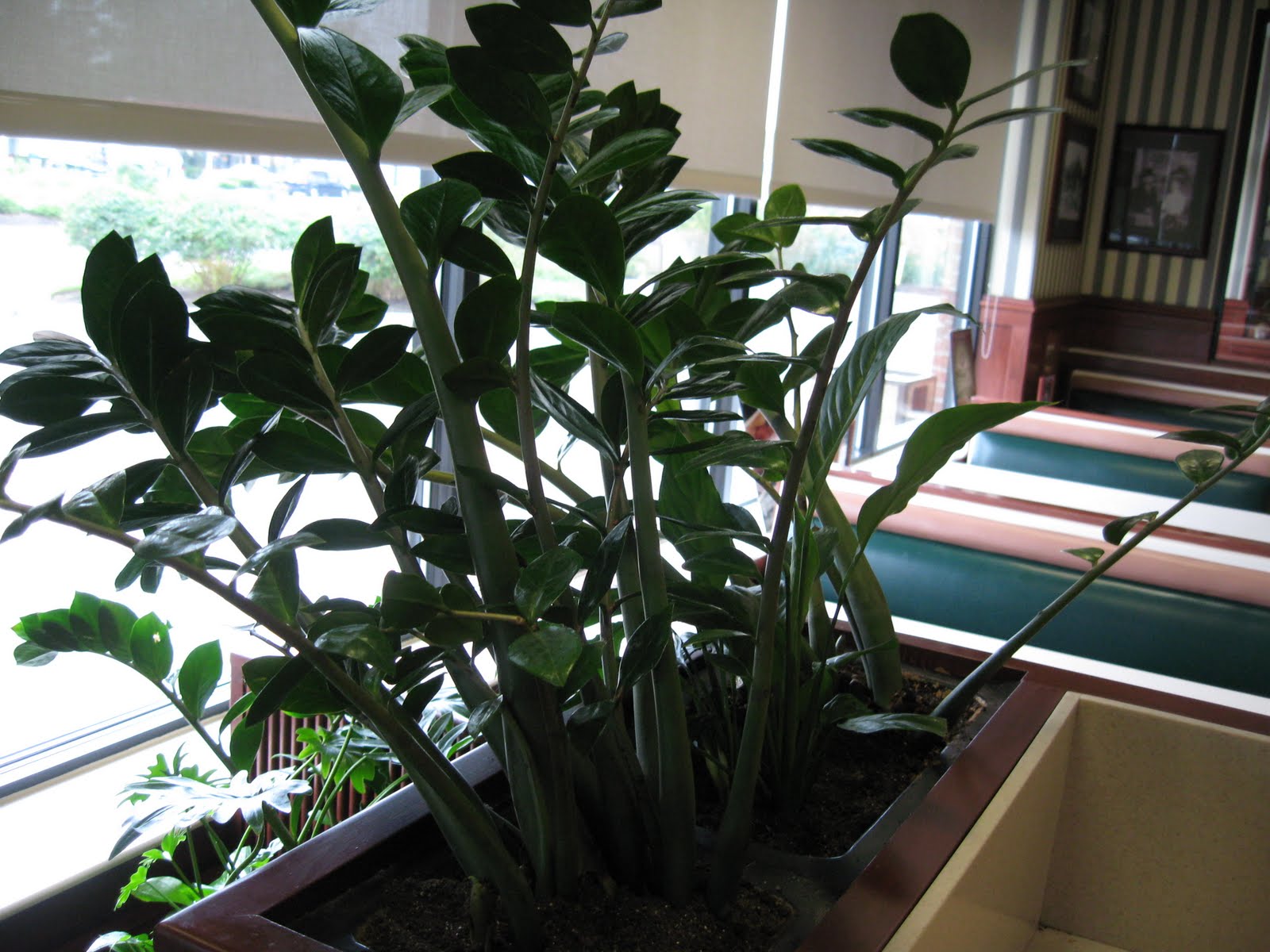
    The above photos are examples of a ZZ plants bending toward the lighted window. Our technician had to rotate it 360 degrees to correct the phototrophic bending of this indoor office plant in Boston, MA. This will evenually correct itself and straighten out.

    Tuesday, August 3, 2010

    How Plantscape Designs Inc. uses cork screw ficus in office interiors.


    PDI uses cork screw ficus trees in office interior lobbies as well as office cafes.

    These tall stately low light ficus trees add character to your office work place.

    Planting these soft leafed botanicals in Lechuza Cubicos further enhances the long elegant lines of these indoor plants.

    Plantscape Designs Inc. currently services the Woburn, MA. office parks.

    Do you know that one of the most popular plants in Europe is the Ficus benjamina
    and its many cultivars.
    There are many perceptions in the US on Ficus trees with differ from Europe
    Ficus drop their leaves
    Ficus are short lived in the interior environment
    Ficus are uninteresting
    Ficus are inexpensive
    A Ficus is a Ficus

    There is nothing new in Ficus
    In fact over 15 years ago Ficus trees accounted for over 11% of all potted plant sales sold and over 60 Ficus varieties were being cultivated commercially.
    Now not all Ficus cultivars are superior but some select varieties are indeed superior. Plus we continue to see new selections both unique in color form and growth habit.

    This image is of a crop of 14 inch Ficus Benjamina ‘Monique‘ trees grown as ‘corkscrews’. These trees are undergoing the acclimation process getting use to lower light levels soon ready to be a conversation item as a houseplant or in an office.
    Ficus Benjamina Monique is more drought tolerant than past benjamina varieties. Learn more on Ficus tree care here.

    Ficus trees are one of PDI main staple plants for your Boston cityscape atriums.


    Wednesday, April 21, 2010

    Why go vertical with your indoor office plants and containers?


    Why go vertical with your indoor office plants and containers?

    First, vertical is the "in" design look for modern contemporary offices today. Vertical takes up less office space in smaller workplaces.

    Second, sleeker, trimmer linear design has a different eye appeal then past 80', 90's and early 2000's jungle look.

    Third, architecturally the new narrow containers are more suitable for your newer constructed offices today, focusing on the shape and finishes of the planters as part of the office furniture design.

    A nicer neater look with fewer more stately presented office plants. PDI uses this design in Waltham , MA cityscapes.